Finding a startup internship
Find relevant teams and make a useful, specific introduction.
By Maybole · Updated November 2026 · About 7 min read
To find a startup internship, choose a problem you could help a team investigate, identify companies working on that problem and check whether they have a suitable opportunity. A specific, truthful introduction is easier to assess than a broad offer to “help with anything.”
Small teams vary widely. Some run structured internships; others do not have the supervision or budget for one. Your search should establish whether the work, manager and terms make sense for you, not only whether you can reach a founder.
Start with a skill and a useful question
| Background | Possible question | A bounded deliverable |
|---|---|---|
| Research and writing | Where do new users get confused in public onboarding material? | An annotated review of a few public pages with suggested clarifications. |
| Engineering | Can a small tool make one repetitive internal task easier? | A prototype and short handoff, scoped with a supervisor. |
| Data analysis | What pattern appears in an approved dataset? | A reproducible analysis with assumptions and limitations. |
| Marketing | How do comparable products describe a specific use case? | A public-message comparison and a short set of hypotheses. |
Choose a skill you can demonstrate with your own work. A short existing project, clear explanation or relevant course assignment may be enough to start a conversation. Do not promise business outcomes you cannot control or volunteer to handle confidential data before an arrangement is agreed.
Find companies, then verify the opportunity
Use your university resources, alumni and startup job directories to discover teams. Y Combinator’s jobs site is one starting point for browsing companies and postings. Read each company’s own careers material and product pages. A directory listing or funding announcement does not prove that an internship exists.
- Look for a product or customer problem you can explain in your own words.
- Check that the team and the role are current.
- Read posted requirements before assuming an undergraduate role is available.
- Keep a short research note connecting your skill to a specific team need.
Make a project pitch concrete
An illustrative project brief. Agree supervision, compensation and scope before doing work.
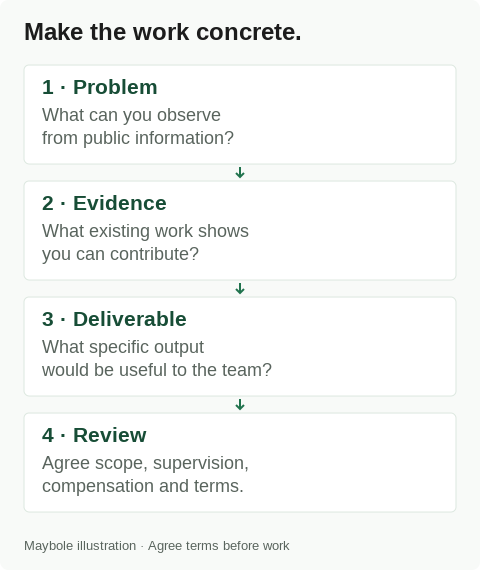
The method at a glance
- Problem
Describe an observable problem in the product or team workflow. Do not invent confidential business needs.
- Evidence
Show a relevant skill or existing example of your work. Avoid speculative unpaid assignments.
- Deliverable
Suggest a bounded output, such as a short competitor map or a small documented prototype.
- Review
Ask who would supervise the work, how it will be assessed and what terms apply.
Choose the person closest to the work
At a very small company, a founder may supervise the relevant work. At a larger startup, an engineering, research, design or marketing lead may be more appropriate. Use the team’s actual structure rather than assuming every founder handles all hiring. If there is a recruiting contact or application instruction, follow it.
Your first email can ask about the team’s problem and whether your background could fit. It should not imply that you have already been invited to contribute. If no opening exists, a professional conversation may still help you understand the field, but respect a decline.
Make a project proposal small enough to discuss
Subject: Student question about developer onboarding
Hi Morgan,
I worked through your public API tutorial and noticed that its examples cover successful requests but have less detail on common errors.
I am a computer science sophomore at State University. In a recent project, I built a small interface that explains failed requests to users.
If your team is considering an intern for developer education, I would be interested to discuss a bounded documentation project and how it would be supervised. Is there an appropriate person or application process to contact?
Thank you,
Casey
The example identifies public material and a student project. It does not say the company needs the work or promise that the proposal will increase revenue. The team may have different priorities. A useful conversation tests the need before either side commits.
Evaluate the internship as carefully as the company
| Area | Ask for clarity on |
|---|---|
| Work | The first assignment, expected deliverables and what is outside the role. |
| Supervision | A named manager, feedback routine and who can answer questions. |
| Terms | Compensation, dates, hours, location, equipment and written expectations. |
| Learning | Which skills you will practice and how the work will be reviewed. |
| Practical fit | Whether the arrangement works with school, living costs and your other commitments. |
If a role’s terms are unclear, ask for a written explanation and use your university career service for help evaluating it. Do not assume that a startup label makes any working arrangement appropriate. This guide does not assess employment-law or immigration eligibility; use qualified campus resources for your individual circumstances.
Follow up with context
A brief follow-up can restate the question and give the person room to decline. Avoid sending a stream of unsolicited project files. If they ask you to reconnect later, record the timing. If the opportunity is unsuitable, leave politely and use what you learned to refine the next company search.
Frequently asked questions
Should I always email the founder?
No. Contact the person closest to the relevant work, using the company’s actual team structure and application instructions. A team lead or recruiting contact may be more appropriate.
Does a recent funding round mean a startup is hiring interns?
No. Funding alone does not establish an opening, suitable work or supervision. Check current postings and ask about the actual opportunity.
Sources and further reading
- Y Combinator: Startup Jobs
A starting point for discovering companies and current job postings; not proof that a company has an internship opening.
Source checked
- Harvard College: Guide to Making Connections
University guidance on identifying contacts, requesting conversations, preparing and maintaining professional relationships.
Source checked
Let Maybole do the hard part
Custom searches require an active paid subscription, an approved legacy trial that has not ended, or usable credits. New subscriptions charge immediately; no free trial is offered to new subscribers. These guides are free to read without signing up.
Search for the people you want to meet. Use credits to add your choices, then set up your profile for personal drafts. You review and send.
Get startedRelated guides