The student cold email guide
Find the right people, write a specific email, and make the conversation worth their time.
By Maybole · Updated November 2026 · About 8 min read
A student cold email is a short introduction to someone you have not met, with a clear reason for contacting them and one modest request. For networking, the useful next step is usually a conversation about their work. A reply is not an interview, a referral or an offer.
Start with a question you want to answer: What does an analyst on this team do? How did this person move into the field? What would help you prepare? That purpose determines whom to contact and what to write. Sending more messages cannot fix a request that has no clear purpose.
Choose someone whose work answers your question
Define a role, firm type and location before looking for names. For a student exploring healthcare investment banking in New York, an analyst or associate on a relevant team may be able to explain the day-to-day work. A senior executive with a recognizable title is not automatically the most useful person to approach.
- Check their current firm and role against a recent professional or employer source.
- Look for a real connection: the same school, an activity you both actually did, or a career transition you want to understand.
- If you have no connection, use a specific observation about their work. Do not turn a shared word into a claimed commonality.
- Keep a research note and its source so you can check the email before sending.
From a target to a conversation
Choose a stage to see the next action. The complete process is written below.
The method at a glance
- Choose
Name a role, firm type and location. Choose someone whose work you want to understand.
- Research
Find one verifiable observation about the person. A real connection is useful; an invented one is not.
- Write
Connect that observation to a short introduction and one specific, low-pressure request.
- Review
Check the name, firm, facts, address and ask before sending from your own mailbox.
- Follow up
If appropriate, send a brief follow-up in the same thread. Respect a decline and stop when asked.
- Prepare
If a conversation is agreed, research the role, prepare questions and record what you learn.
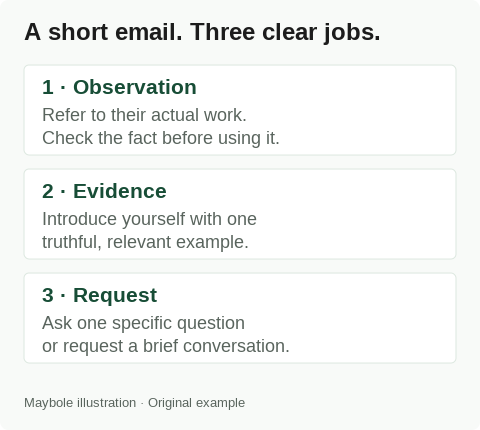
Give the email three clear jobs
The opening explains why this person. The introduction explains who you are and why the question matters to you. The request makes the next action clear. Short paragraphs help the recipient see those jobs without searching through a résumé in prose.
Subject: Economics student asking about healthcare advisory
Hi Morgan,
I read your team’s public overview of healthcare advisory and would be interested to hear how analysts learn the sector.
I am a sophomore studying economics at State University. A recent class project on hospital consolidation led me to explore this work.
Would you be open to a brief conversation about your role? I would be happy to work around your schedule.
Thank you,
Casey
This example does not claim that Casey and Morgan share a background. It connects a checked observation with a truthful reason for asking. If your experience is a course, club or independent project, say that plainly. You do not need to invent professional experience.
Review before you send
| Check | What to confirm |
|---|---|
| Recipient | The name, current role, firm and work address belong to the person you intend to contact. |
| Observation | You can point to a source for the fact you mention; it is relevant to your question. |
| Introduction | Your school, class year and experience are accurate. |
| Request | There is one specific, reasonable next action. |
| Attachments | If including a résumé, use the correct current PDF and a recognizable filename. |
Use a subject that describes the message. A school connection or specific topic can help the reader place it. Avoid fake reply prefixes, urgency or claims of a referral that did not happen. A university address can help identify you, but it does not excuse a generic or inaccurate message.
Follow up with a reason, then leave room
If you have not heard back after roughly a week, a short follow-up in the same thread is a reasonable starting approach. This is a practical cadence, not a proven best interval. Adjust for holidays, deadlines or a reply that asks you to reconnect later. Do not keep messaging someone who has declined or asked you to stop.
Subject: Same thread as the first message
Hi Morgan,
I wanted to follow up on my note about healthcare advisory. If a brief conversation would be possible, I would appreciate the opportunity to hear about your work. I understand if your schedule does not allow it.
Thank you,
Casey
Turn an agreed conversation into useful learning
- 1Confirm the time and time zone. Read the person’s background and the team’s public material again.
- 2Prepare a few questions that cannot be answered by reading the homepage. Ask about tasks, preparation, decisions and what surprised them.
- 3Keep your introduction brief. Respect the agreed time and listen rather than delivering a long pitch.
- 4Send a specific thank-you. Record what you learned and any next step they actually offered.
- 5Apply the advice. A later relevant update is more useful than repeatedly asking for a referral.
Use Maybole for the search and drafting work
In Maybole, verify your email and open Finder. Custom searches require an active paid subscription, an approved legacy trial that has not ended, or existing usable credits. With search access, preview people matching your criteria. Choose whom to add using credits. From Contacts, explicitly request personal drafts; complete résumé, reviewed background and templates when prompted, then return and explicitly Generate. Review each draft and send from your own mailbox. Reading a guide or saving setup never starts sending.
Frequently asked questions
Can I cold email without an internship on my résumé?
Yes. Introduce yourself honestly through your studies, a project or the question you are exploring. Ask for learning rather than implying experience or a relationship you do not have.
Should the first email ask for a referral?
Usually start by asking about the person’s work or path. A referral is a separate decision for the recipient; a conversation does not create an obligation to provide one.
Does Maybole send the emails automatically?
No. You review the drafts, choose mailbox delivery and send from your own mailbox. Contact selection, draft generation and sending are separate actions.
Sources and further reading
- Harvard College: Guide to Making Connections
University guidance on identifying contacts, requesting conversations, preparing and maintaining professional relationships.
Source checked
- Harvard Law: Sample Networking Emails and Thank You Notes
Reference for professional correspondence structure; Maybole examples below are original, with undergraduate and JD contexts kept separate.
Source checked
Let Maybole do the hard part
Custom searches require an active paid subscription, an approved legacy trial that has not ended, or usable credits. New subscriptions charge immediately; no free trial is offered to new subscribers. These guides are free to read without signing up.
Search for the people you want to meet. Use credits to add your choices, then set up your profile for personal drafts. You review and send.
Get startedRelated guides